
(Even When We’re Not)
Good. Fine. Okay. Simple responses to a simple, overused question.
“How are you?” We hear it so often, our response becomes muscle memory. The person asking us doesn’t REALLY care about our response, they are just doing what is expected. They say it in passing, expecting nothing short of a one word reply. Even on days when our cheeks are tear-stained and our shirts are covered in spit-up and food. Even when our mind is spiraling, full of open tabs and to do lists. Even when our car and house are cluttered, and our world is in absolute chaos.
“Fine.”
Why do we refrain from answering the question honestly? Is it because we don’t want to pour our sorrow onto another’s day? Is it because we don’t think anyone will understand? Is it due to a building pressure to, in fact, be “fine?”
Whatever the reason, by answering “fine,” we slowly start to eliminate chances in life to truly connect with others. We eradicate an opportunity to be vulnerable, to show humility. It is okay to be fine. But it’s also okay to not be.
Now, to be fair. Some mornings are better than others. The kids wake up and get dressed on their own. There is no fighting, there is no rushing, no forgetting. We pull up to the drop off with smiles and Forrest Frank jamming in the background. I walk into work and smile at a coworker as I pass them. They ask, “How are you?”
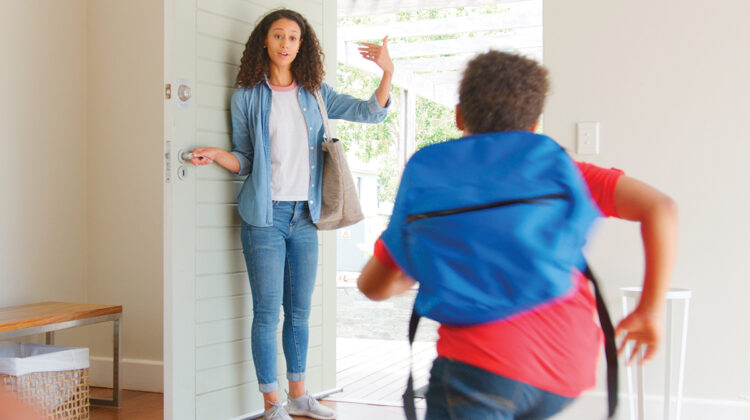
Being a mom is a constant state of survival. Some days, you will feel inadequate. You wake up to be smacked in the face with hustle and hormones. You have one kid who will not get out of bed. Despite the threats, the pulling off of the covers, she will not budge. Another one is awake, but has somehow put on clothes that don’t match and her shoes on the wrong feet. Two are tackling each other in the hallway, half way dressed and fully energized. And the last one is crying to be held and cuddled when you simply don’t have the time. The hour you have given yourself has quickly turned into minutes and you’re uncertain if you have even brushed your teeth. You get to drop-off on time. But, someone forgot something.
“You have to be more responsible!”
“I do NOT have time for this!”
After rushing home, recovering the “forgotten” item, and delivering it, you FINALLY walk into work. You are flustered. You feel angry. You feel shame. And in the sprint to your room/office, you almost run right into a coworker as they ask, “How are you?”
“Fine.”
Any rational, normal human being would be able to tell by your messed up hair, tear stained face, body language, and speedy response that you are NOT in fact fine. So why do we feel the pressure to say we are?
Because everyone else besides us is fine, right?
They all had the perfect morning, with perfect behaving kiddos, and a perfect drive to school. Right?
Wrong.
What if I took a minute and stopped and truly responded. What if I told my coworker about my day? Told them that I felt shame in the way I spoke to my kid that morning. That I felt flustered and unsettled by my morning. Maybe in that moment, my word vomit may come off as a surprise, catching them off guard. But imagine the long term impact of a simple, genuine conversation. Quite possibly, they may see a side of me they never knew. All this time, they had a perception of me that I was a negative, unapproachable person. I have just given them insight into my life and slowly showed them parts of my heart. Imagine in the future, when they are struggling with similar thoughts of inadequacy and shame that they remember you too struggled, as do many others.
What about our own children?
I don’t know about yours, but when I ask my kids how school was, their responses are always, “fine.” Do we not see a pattern? Of course, our kids are going to emulate what we do and say. I want to model for my kids that it is okay to not be okay. I want to encourage them to tell me the truth about their day, no matter how “unfine” it may have been and I want them to feel the freedom to do the same with others.
I find there is power in authenticity. For a long time, I lived in hiding of my true self due to feelings of shame and guilt. I cannot let anyone know I do not have it all together. I MUST be fine. I must LOOK fine. What I have learned throughout my decade of being a mom is that my kids do not learn from me on my good days. They must know that there are going to be bad days. And other parents need to hear that you have bad days too. There is zero room for comparing in parenthood. Being authentic allows real conversations to happen that may open the door to real and authentic friendships and more importantly, teachable moments for my children.